
BLOG
Find support not just for emotional eating, but all aspects of your well-being.
Supporting Your Mental Health at Work
No matter what you do for work, chances are it is a stressor in your life. Even if you enjoy your job, there might be tasks or colleagues you’d rather not deal with. Work is a necessity not just for income, but also purpose, goal setting, community, and future planning.
That doesn’t mean it isn’t stressful.
Below are a number of ways you can support your mental health as a worker.
Basic Maintenance Goes a Long Way
You might already know that routines, rituals, and structure can support your well-being, so focusing on identifying working hours (and rest or play hours), practicing good sleep hygiene, and implementing boundaries around your work phone or logging in can be incredibly helpful for supporting your mental health. It can also be helpful to create a transition ritual where you let your nervous system know that you are changing from work you to home you. Listen to a meditation app on your commute or change clothes as soon as you are home. These can signal to your body that it...
Real Scripts You Can Use this Holiday Season
Social gatherings can be stressful at the best of times: they require your time, energy, money, and you have to figure out what to wear. Add in the expectation that someone will comment on your weight, what you’re eating, how you vote, or how you choose to live your life and the anxiety can build as soon as the event is on your calendar.
If you are already dreading a few get-togethers on your calendar, below are some helpful scripts you can use to shut down unwanted comments and criticism. Read through and choose which ones might be helpful to you. Feel free to bookmark this blog post or take a screen shot on your phone so you can come back to this anytime you need to feel empowered to redirect an uncomfortable conversation.
Try being warm and polite:
- “It’s the holiday season, let’s focus on the positive. What are you excited about right now?”
- “Let’s keep things light today. Tell me something wonderful that’s going on with you lately?”
Try being gentle but clear:
- “That is ...
How to Set Personal Boundaries
Setting boundaries with other people can feel very challenging. It pushes against our desire to keep the peace, challenge those we love, out of fear of rejection. But they are an essential part of maintaining your well-being and healthy relationships.
Benefits of Boundaries
Your boundaries are personal to you—they’re the guidelines you set to protect your body, mind, energy, and lifestyle. That’s a pretty powerful thing. For example, setting boundaries with others can include how frequently or quickly you respond to calls and texts, saying “no” when you don’t have time or interest in something, or pushing back on critical comments.
While you might feel uncomfortable to set boundaries, doing so can support your mental health, financial stability, help you feel more confident, and even create healthier relationships. Often others will respect you for knowing what you are and aren’t comfortable with, and stick with it.
While you may need to communicate your boundaries to others, you d...
Create A Routine That Brings You Peace
Routines don’t have to be boring! One of the best ways to create certainty and predictability in your life is to have routines, structure, and rituals. These can be big or little things: taking the same route to work or buying the same shampoo so you’ll know how it will smell. It can be having Taco Tuesday’s or reading 30 minutes before you turn the light off for sleep.
Here are three key ways routines can support you:
Helps support your sleep. This is probably one you’ve heard of, but a good routine or ritual before bed can help you get a better night’s sleep because it keeps your body on the same wake-and-sleep ‘clock’. Try lowering the lights (even lighting a candle), putting your phone on silent, or watching your favourite comfort show.
Creates a sense of safety and reduces stress. The predictability of knowing what comes next is a great way to calm your nervous system. Consider the times you worry or are anxious about a situation, chances are you can’t predict how it will turn ...
Reparenting: Learning to Support the Younger You
Often here at the Centre for Emotional Eating we talk about how your patterns and habits with food are influenced not by the cravings themselves, but the root cause behind what makes you act.
For many, the root cause can be found in childhood or adolescent experiences. This is because as our brains and bodies grow, we are learning and are influenced by examples displayed around us—to finish what’s on our plate, diet talk, stuffing down emotions, just to name a few. We learn from parents, caregivers, teachers, coaches, siblings, and friendship circles! But not all of these lessons will serve you as you grow into your own adulthood, some might be downright painful or destructive.
It is incredibly common to reach a point in your adult life and know things need to change but not know how. This is where therapy can be a very helpful tool in helping you sort through your thoughts and feelings, gain confidence to make your own decisions, and help you feel more resilient.
And one effective ...
Let’s Talk About It: The Rising Popularity of GLP-1 Drugs
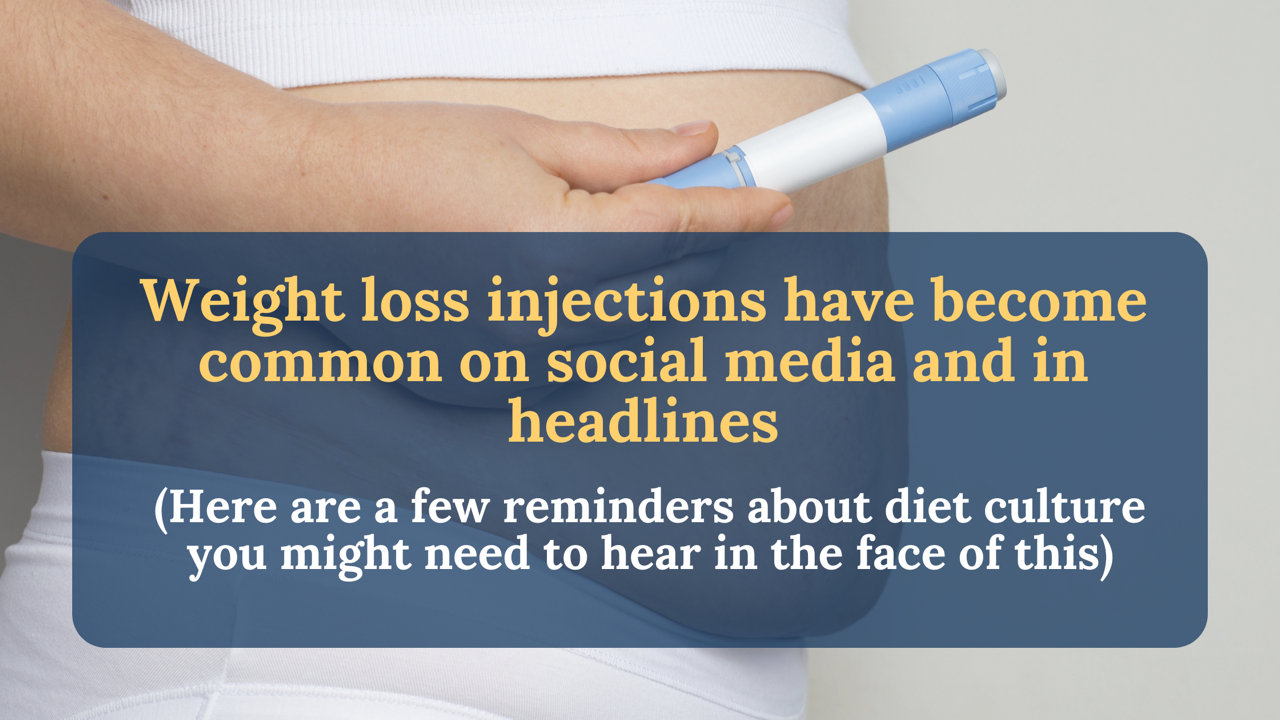
It seems impossible to ignore the presence of GLP-1 medications, you might have heard them being called Ozempic or Wegovy. Diet culture seems to have evolved from a focus on willpower to injections that can give you the “body of your dreams.”
It can be especially difficult to see celebrities who were previously promoting body positivity and self-love admit to taking weight loss injections. It can feel like a betrayal. And some, like influencers on social media, aren’t being transparent about their use of the drug but continue to say only diet and exercise are responsible for their results.
Plus, all these headlines, photos, and videos can make you hyper-aware of your own body as we’re encouraged to compare ourselves to others. You might find your emotional eating—reminder, that can include restricting too—ramps up the more you’re faced with this kind of content. It can be a constant reminder that weight loss is celebrated and only one body type is “acceptable.”
Here are some loving ...
Make Your Own Holiday Traditions

There is something about the holidays that bring out our perfectionist side. From the ideal tree to picture-worthy cookies, flawlessly wrapped gifts to lights decorating your home, it seems there is only one vision of the holidays... And it is a very detailed, expensive, and time-consuming vision. It might be a magical season, but that magic is created by us!
That also means you get to decide what makes the holidays special!
Think of this blog as your permission slip to celebrate the season in a way that feels good to you… not just look good! We grow up with all kinds of traditions of what we’re “supposed” to do to celebrate, but the truth is, there is no wrong way to celebrate the season!
Here are some ideas to get you started:
- Decorate when and how you want. If twinkle lights hung in November makes you feel joyful and cozy, put them up! If it stresses you out to decorate right now, you can wait or only pull out only a few decorations when you feel like it.
- Have a potluck with ...
How to Avoid the Social Media Comparison Trap
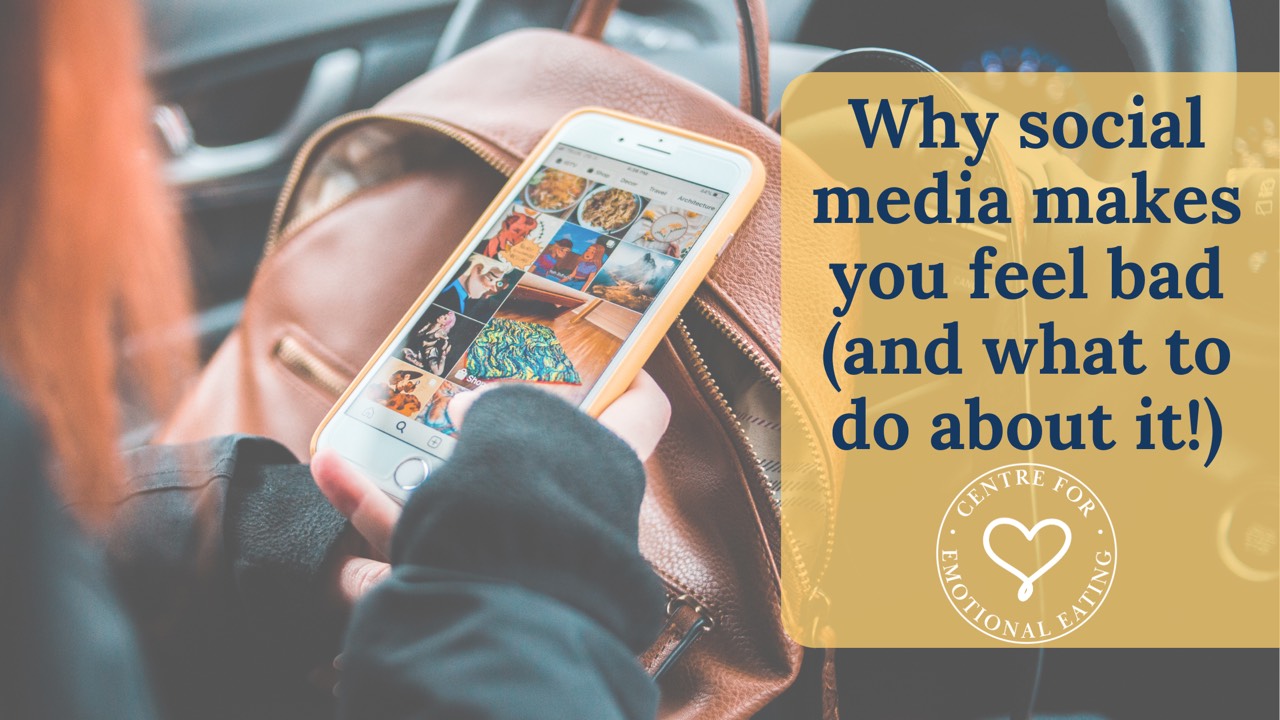
Social media constantly gives us benchmarks to compare ourselves to.
Your Instagram and TikTok feeds are filled with picture-perfect videos and photos of happy kids, clean houses, and expensive vacations. These platforms are also overwhelmed with weightless “success” stories and details of restrictive diets to try to ‘give’ you the body of the influencer posing on the screen.
It’s tough not to get caught up in these images! It’s true that a picture is worth a thousand words, so even before reading the caption or hearing what they’re saying, the image they are projecting is perfection. They are trying to sell you on the idea that if you buy this, do that, you can look just like them, have a life just like theirs.
Talk about a comparison that is only going to make you feel bad about yourself.
But this slim slice we see of others online—a highlight reel—is no yardstick for your own messy, beautiful life!
Here’s the solution to social media comparison:
- You’ve probably heard this be ...
Aligning Your Values with Your Relationships
When it comes to supporting our mental health, we tend to start with the big things: the quality of our sleep, what we eat, going to therapy, taking medication. This can lead to more confidence and awareness which are powerful tools! But you might also begin to notice that working on yourself has shifted your relationships with others in ways you didn’t expect.
As you implement changes in your life and your perspective shifts, you might find you grow annoyed or feel critical towards others you usually have felt ok around. You might even feel like you can’t show or talk about who it is you’re becoming. Your immediate reaction might be to blame yourself, piling on the guilt that you’re a “bad friend” or a “bad person” because you’re thinking about others differently, even critically.
If you dig past those uncomfortable feelings, you’ll notice that it isn’t about them, but that getting clearer on your values (and setting boundaries that go along with them) means you no longer align with...
Client Insight: “My emotional eating led to weight loss—it was celebrated, but I felt awful.”

It’s true that we never really know what someone else is going through. We’ve covered in another post how not all emotional eaters are overweight, and sometimes emotional eating can lead to weight loss in an unexpected way.
For some clients, when emotions run high, they feel the need to control their eating as a way of trying to control their lives. For them it feels like the only thing they have power over is what they put in their mouth—not their kid’s tantrum, their boss’s feedback, or their partner’s attitude.
While in this scenario there is an absence of food, instead of a binge, it is still emotional eating because a person’s eating pattern has changed in response to emotional experiences. For example, this can look like telling yourself you’re too busy to eat, believing you’re not worthy of nourishment, not having motivation to cook and eat, or feeling a physical surge of anxiety that makes your stomach queasy. Experiencing these actions long enough can lead to weight loss.
T...

