
BLOG
Find support not just for emotional eating, but all aspects of your well-being.
Set Goals with Self-Compassion
With the start of a new week, month, or year, it can be tempting to overhaul your life. This might look like starting a new diet, adhering to an intense exercise regime, doing a detox, or trying to white-knuckle your way to change.
How often have you tried this approach?
It isn’t a bad thing to want to change your habits, but how often does your motivation start out from a place of criticism or feeling not good enough? You can’t hate yourself towards change. Instead, coming from a place of compassion is a great way to soothe and support yourself!
Consider The Words You Use
When coming from a place of compassion, you don’t tear yourself down by picking apart your body or criticizing your abilities. This inner critic can be really mean! You can start by asking these two helpful questions when this inner voice gets loud. The next step is to start changing the words you use to talk about yourself. It doesn’t have to be fake or super positive, you can aim for neutral comments like “I am...
Befriending Your Inner Critic
Managing your inner critic can be difficult. Its comments are cruel, judgmental, and criticize everything from your body to your intelligence to your dreams. That voice inside tears you down with comments taken from friends, family, society, and social media. Sometimes they are word-for-word and sometimes your inner critics twists them to be extra painful. We tend to internalize these negative ideas and our brain feeds them back to us as if they are true.
They aren’t.
There are a few ways to address your inner critic. I’ve talked before about how to push back against these inner comments (without falling into toxic positivity!) and today I want to give you another strategy to try out: listening to your inner critic.
Now, that doesn’t mean believing your inner critic. When thoughts like “You’re so dumb” or “No one likes you” come up, see if you can sit with them for a moment. These thoughts often jump to the surface when you’ve been triggered by a situation and your immediate action ...
Food Noise Explained: Why It Happens and How to Find Peace with It
It is common to think about food: what you have to pick up at the grocery store, your weekend dinner out with friends, or even if you want a pastry to go with your coffee.
But when your mind is running a constant dialogue focused on your next meal or snack, how much and when you’ll eat, chances are you’re experiencing food noise. You might have come across this term online, so today we’re breaking down why you can’t stop thinking about food and what to do about it.
What is food noise?
We can define it as a preoccupation with food before, during, and after you eat—so all the time! This can come in the form of questions or criticisms. Do any of these sound familiar?
- “I just ate but I’m still hungry. I shouldn’t eat any more, but I kind of want more potatoes, they were so creamy, probably full of butter…”
- “I have ice cream in the freezer. I shouldn’t eat it. I want it. I’m going to eat it. That was so good, what more can I have? I’ve already had the ice cream, I’ve blown it, I’ll j ...
Let’s Talk About It: The Rising Popularity of GLP-1 Drugs
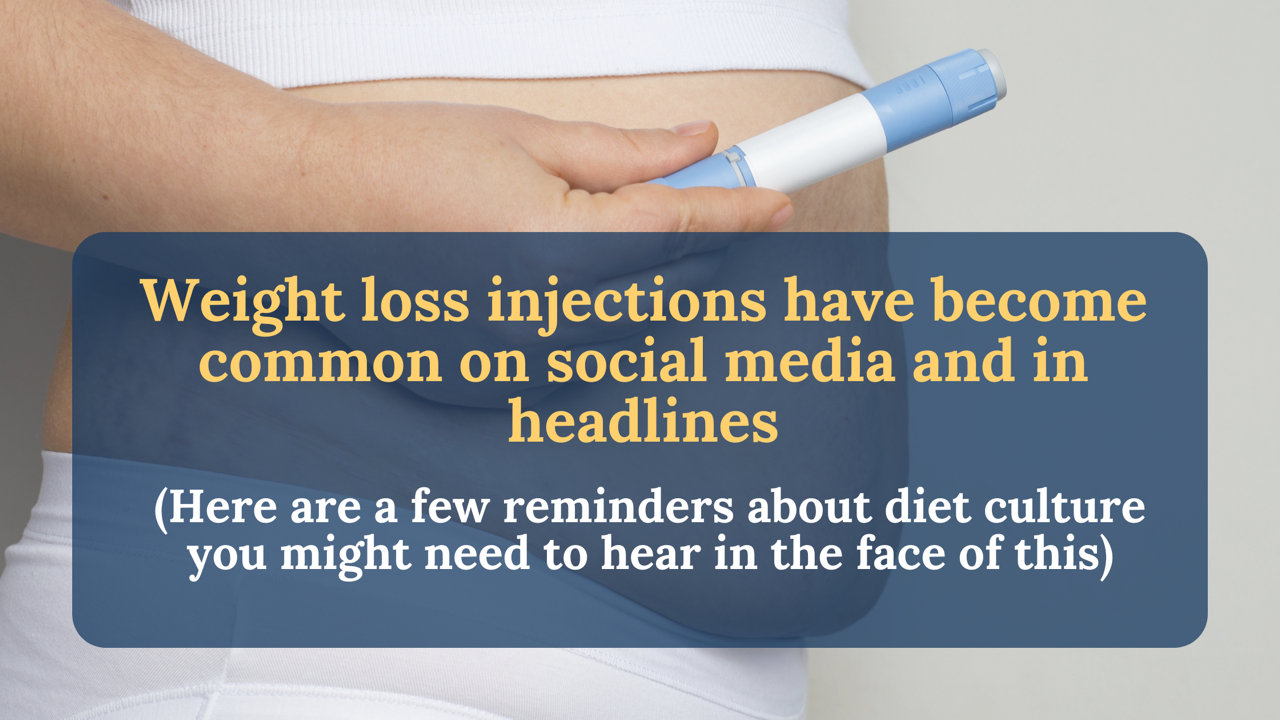
It seems impossible to ignore the presence of GLP-1 medications, you might have heard them being called Ozempic or Wegovy. Diet culture seems to have evolved from a focus on willpower to injections that can give you the “body of your dreams.”
It can be especially difficult to see celebrities who were previously promoting body positivity and self-love admit to taking weight loss injections. It can feel like a betrayal. And some, like influencers on social media, aren’t being transparent about their use of the drug but continue to say only diet and exercise are responsible for their results.
Plus, all these headlines, photos, and videos can make you hyper-aware of your own body as we’re encouraged to compare ourselves to others. You might find your emotional eating—reminder, that can include restricting too—ramps up the more you’re faced with this kind of content. It can be a constant reminder that weight loss is celebrated and only one body type is “acceptable.”
Here are some loving ...
How to Build Trust in Yourself

If you’re an emotional eater, you might have spent a lot of your life trying to stick to a diet or workout routine created by someone else only to keep feeling like you fail. This can grind down your sense of self-trust: you keep trying to live by the rules of others, not trusting your inner voice, and you keep feeling like you’re breaking promises to yourself by not following through.
Talk about being stuck in a loop!
It is time to start rebuilding your self-trust, an inner knowing that you are capable and have preferences. But how can you do that if you’ve been ignoring your inner voice for so long? Try thinking about how you support the people in your life who you love and then apply it to yourself. You might find that it feels easier to trust and show up for others than it is to show yourself the same level of support and compassion.
Here are a few specifics to think about:
Keep a promise to yourself. Start off with little things like setting the intention to brush your teeth b...
Why We Engage in Self-Sabotage Behaviour
Self-sabotage is a sneaky habit that is getting in the way of, well, yourself! You might have recognized your patterns, even be aware it doesn’t make you feel good, but feel helpless to stop the action. Self-sabotage keeps you feeling stuck because there is familiarity in the outcome. Yes, it might leave you feeling shame or overfull but it feels safe.
Self-sabotage behaviour can look like:
- Perfectionism. Needing everything to be perfectly aligned and ready before taking action. But the truth is “perfect” doesn’t exist, meaning you’ll never end up taking that step forward.
- Procrastination and avoidance. It is easy to pick up our phones and scroll or focus on what foods we want to binge on as a way to numb out rather than face something.
- Constant self-doubt and criticism. This can be feeling like you never measure up or that you can’t possibly meet your goals, so why even try.
These patterns of self-sabotage show up not just around a fear of failure, it can also come up as a fe...
How to Deal with an Endless To Do List

Checklists can be a helpful tool: they can organize your day and make you feel motivated. But when it feels like you’ve got a never ending to do list, you can feel defeated and constantly drained.
You might even find yourself unable to relax or feel like you haven’t ‘earned’ rest because of all the lingering things you need to get done. With this mentality it is easy to fall into emotional eating patterns to avoid your to do list.
Food becomes the only ‘acceptable’ way to take a break, so you go grab an afternoon pastry to get away from your desk or find yourself in the pantry looking for a snack to focus on something other than your tasks. This pattern of eating also packs a one-two punch of helping you disassociate from your to do list and all the feelings around it: stress, overwhelm, anxiety, fear.
It is unavoidable that life will get busy, but that doesn’t mean you have to live in a constant state of stress eating. Here are four key strategies to bring you some peace of mind, ...
Client insight: “Emotional Eating is my Comfort… And it’s Comfortable”
After working with emotional eaters for more than a decade, it is common to hear from clients that they don’t understand why they keep emotionally eating when it makes them feel terrible.
They can’t stand the overfull feeling after a binge.
They hate hiding from others and sneaking food.
They judge their worth by thinking they need more willpower to get their shit together.
They dread the judgement, guilt, and self-hatred that comes after eating.
They’re ashamed of how much money they spend on food.
For something that is supposed to bring a sense of comfort, these things sound like anything but! So, why are you stuck in this emotional eating cycle when you know it doesn’t feel good? It isn’t about cravings for specific foods or an “addiction to sugar.”
It is because emotional eating is familiar. It is the predictability, even the negative side of it, that offers you a sense of comfort. You know what to expect and our brains are wired to go with what we know. Yup, even when what ...
How to Avoid the Social Media Comparison Trap
Social media constantly gives us benchmarks to compare ourselves to.
Your Instagram and TikTok feeds are filled with picture-perfect videos and photos of happy kids, clean houses, and expensive vacations. These platforms are also overwhelmed with weightless “success” stories and details of restrictive diets to try to ‘give’ you the body of the influencer posing on the screen.
It’s tough not to get caught up in these images! It’s true that a picture is worth a thousand words, so even before reading the caption or hearing what they’re saying, the image they are projecting is perfection. They are trying to sell you on the idea that if you buy this, do that, you can look just like them, have a life just like theirs.
Talk about a comparison that is only going to make you feel bad about yourself.
But this slim slice we see of others online—a highlight reel—is no yardstick for your own messy, beautiful life!
Here’s the solution to social media comparison:
- You’ve probably heard this be ...
Client Insight: “I lost weight, but my brain still criticized my body size.”
The following blog posts talks about weight loss. If this is something that might bring up negative feelings for you, please skip this post to protect your mental and physical health.
Weight loss can happen for all kinds of reasons, from anxiety to happiness to stress to a change in routine. So, it should come as no surprise that emotional eaters come in all shapes and sizes! What I often hear from clients who have lost weight on their journey is that they still find themselves criticizing their body in the same way as when they weighed more.
Does that surprise you?
Many people I work with at the Centre for Emotional Eating believe that if they could just “get a handle” on their emotional eating that everything would all into place—their waistline would shrink, they’d be a kinder person, get that promotion, they’d finally do that thing they’ve always want to.
This is why dieting is so tempting: it markets itself as a cure-all when in reality it keeps you stuck in failure mode beca...

